


How to Get More Google Reviews for Your Business in India: The Complete Guide

If you ask ten Indian business owners how to get more Google reviews, most will say the same thing: "Bas customers ko bol dete hain review daal dena." And that's usually where it ends. No system, no follow-up, just a verbal ask that most customers forget within an hour of walking out.
Here's the thing getting more Google reviews isn't really about asking harder. It's about removing every bit of friction between a happy customer and the review box. This guide walks through what actually moves the needle, in order of what matters most, based on what's actually working for local businesses right now.
Why Google Reviews Matter More Than You Think
A customer deciding between two similar shops almost always checks the star rating and review count before anything else. It's not just about the number either Google's local ranking algorithm itself factors in review quantity, review quality, and how recently reviews came in. A business with 40 reviews from six months ago ranks differently than one with 40 reviews spread evenly and updated every week.
So this isn't just a trust-building exercise for customers. It's a direct lever on whether your business even shows up when someone nearby searches for what you sell.
The Biggest Reason Businesses Don't Get Enough Reviews
It's almost never that customers were unhappy. Most businesses that struggle with reviews have plenty of satisfied customers walking out every day they just never got asked at the right moment, in the right way. A happy customer who isn't asked simply doesn't think about leaving a review on their own. That's not laziness, that's just how people behave. Reviews need a prompt, and the prompt needs to be easy to act on.
Step 1: Ask at the Right Moment
Timing matters more than almost anything else here. The best moment to ask is right after the customer has experienced the good part — right after the meal, right after the service is done, right after they've picked up their order. Asking a day later, or through a generic monthly SMS blast, gets a fraction of the response.
Step 2: Make It a One-Tap Action, Not a Task
This is where most businesses lose the most reviews without realizing it. If a customer has to open Google, search for your business, find the review section, and then think of what to write — you've added four steps between "yes I'll do it" and an actual published review. Most people drop off somewhere in there.
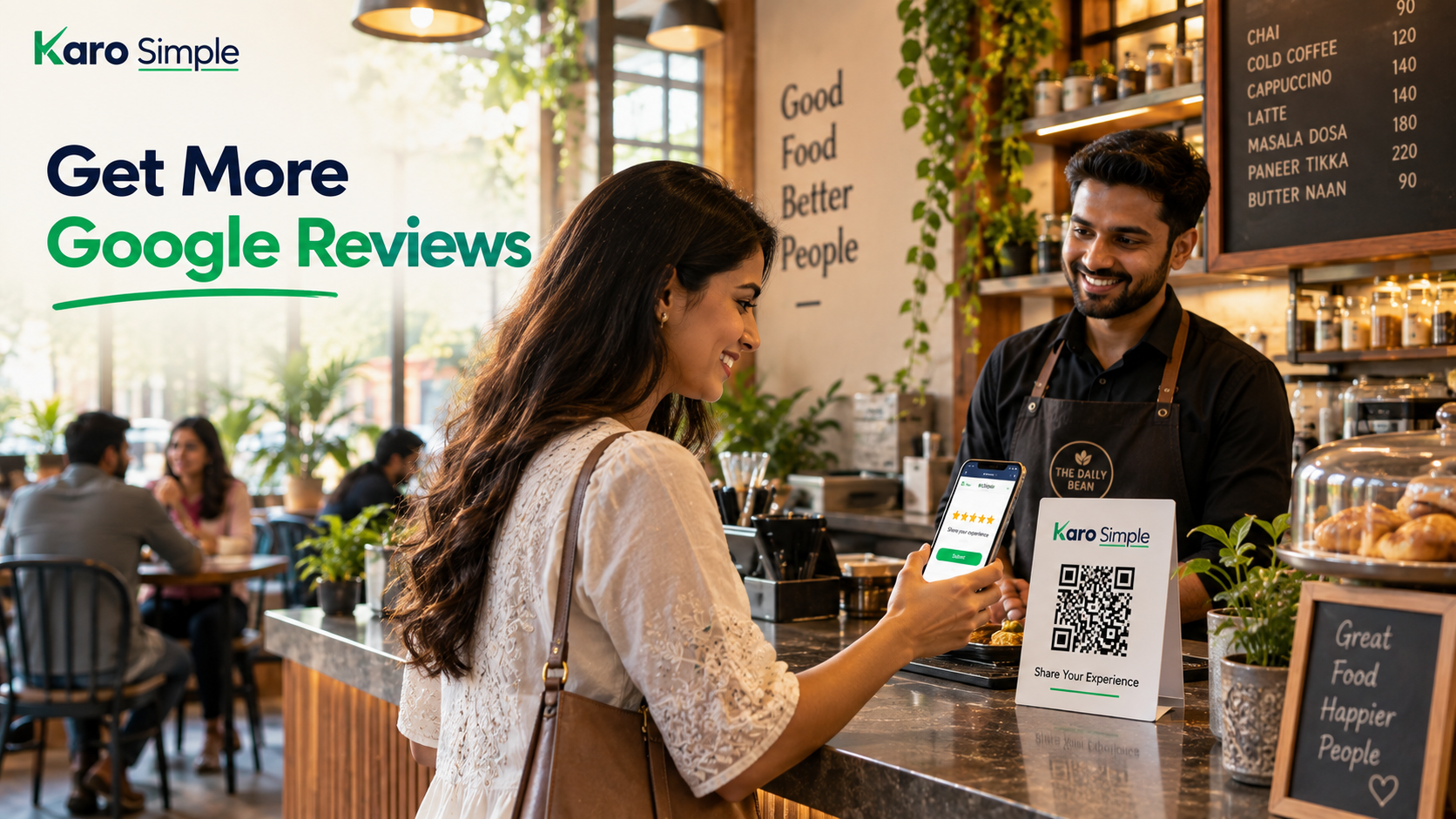
A QR code at the counter that takes the customer straight to your review page removes almost all of that friction. We've written a full breakdown of how to set this up in [QR Code for Google Reviews: The Easiest Way to Collect Reviews at Your Counter].
Step 3: Let Customers Write in the Language They're Comfortable In
A huge number of Indian customers think and express themselves in Hindi, not English. If your review flow silently assumes English, you're losing the reviews of exactly the customers who'd write the most detailed, specific feedback. This one change alone tends to increase both review volume and review quality. There's a full guide on this here: [How to Get Google Reviews in Hindi].
Step 4: Use WhatsApp, Not Just a Counter Card
A QR code at the counter only works if the customer remembers to use it before they leave. WhatsApp closes that gap — it's the one app almost every Indian customer checks within minutes of getting a message. A well-timed, personal WhatsApp request consistently outperforms a counter card sitting there hoping to get noticed. Templates you can copy directly are here: [WhatsApp Review Request Message Templates for Indian Businesses].
Step 5: Protect Yourself From Bad Reviews Going Public
Not every customer walks out happy, and that's normal for any business. What separates businesses with strong ratings from the rest isn't that they never get an unhappy customer — it's that they catch that feedback privately before it turns into a public 1-star review. This is where a system like a Negative Review Shield comes in, routing low ratings to a private feedback form instead of straight to Google. Full explanation here: [What is a Negative Review Shield?].
Step 6: Don't Chase Quantity at the Cost of Quality
It's tempting to just push for as many reviews as possible, as fast as possible. But a wall of generic one-line reviews ("nice," "good service") doesn't build trust the way a smaller number of detailed, specific reviews does — and Google's algorithm reads the difference too. We've broken this down in detail here: [Quality Reviews vs Quantity Reviews: Which One Actually Grows Your Business?].
Common Mistakes That Quietly Hurt Your Rating
- Buying or incentivizing fake reviews. Google actively detects and removes these, and repeated violations can get your entire business listing suspended.
- Only asking during a promotion or campaign, then going silent for months. Google rewards consistency — a steady trickle of reviews looks more natural and ranks better than a sudden spike followed by nothing.
- Ignoring existing reviews, good or bad. Responding to reviews, especially negative ones, is itself a trust signal that both customers and Google notice.
- Making customers write in English when they'd naturally write in Hindi or a regional language, cutting off your most engaged reviewers before they even start.
How Karo Simple Brings All of This Together
Doing all six steps manually, for every single customer, isn't realistic for most business owners. Karo Simple was built to handle this as one system instead of six separate habits: a QR code at your counter (or an automatic WhatsApp trigger) opens a review flow where the customer picks their language, gets an AI-suggested review to make writing effortless, and gets privately routed away from Google if their experience wasn't great. The result is simply more reviews, in the right language, without the risk of a bad one going public.
Conclusion
Getting more Google reviews isn't about convincing more customers to like you most of them already do. It's about making it effortless for them to say so, at the right moment, in the way they're most comfortable. Fix the friction, and the reviews follow.
Want this entire process running automatically for your business? Start free with Karo Simple.
FAQs
How many Google reviews does a business need to rank well locally?
There's no fixed number, but more reviews combined with a steady, recent flow tends to outperform a business with a lot of old reviews and nothing new coming in. Consistency matters more than hitting a specific count.
Can I ask customers for a Google review directly?
Yes, this is completely allowed by Google as long as you're not offering payment, discounts, or incentives in exchange for a review, and not asking only customers you expect to leave positive feedback.
What's the fastest way to collect more Google reviews?
A QR code at the point of purchase combined with a well-timed WhatsApp follow-up, both in the customer's preferred language, is currently the most effective combination for Indian local businesses.
Is it against Google's policy to filter out negative feedback before it's posted?
No. Privately asking a customer for feedback before they decide whether to post publicly is allowed. What's not allowed is offering an incentive only to customers likely to leave a positive review, or blocking a customer from posting on Google altogether.
Comments (0)
No comments yet. Be the first to share your thoughts!